Chino, California. 1991. A cow pasture.
That is where it started. Not a venue, not a speedway, not a desert basin capable of holding half a million people. A field surrounded by dairy farms in the Inland Empire, roughly 35 miles east of Los Angeles, transformed by a small group of friends into something that had never existed quite like this before on American soil.
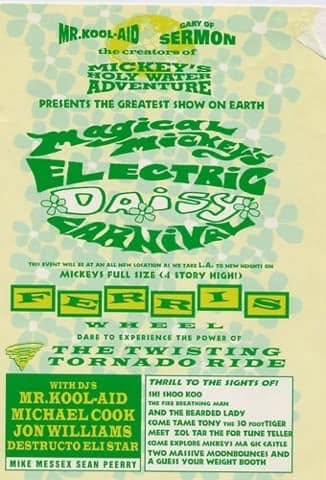
The event was called Magical Mickey’s Electric Daisy Carnival. And the word “magical” was not marketing. It was a mission statement.
Stephen Hauptführ had been throwing underground parties in Southern California since 1986, back when he was still a teenager, back when what is now called rave culture had no name and almost no audience in the United States. He had spent time as an art student in London, where the UK’s acid house movement was erupting out of clubs and warehouses with a force that would eventually reconfigure popular music for the next three decades. When he came home to Los Angeles, he tried to bring that sound with him. Other promoters in the local scene turned him away. “We had friends who put on events, but they wouldn’t hire us because they said no one wanted to hear this music,” Hauptführ later recalled.
He threw his own events anyway.
Hauptführ worked with a collaborator early in this period who would go on to become one of the most significant figures in American dance music: Gary Richards, known in his DJ incarnation as Destructo, and known later as the founder of HARD Events, the company that launched careers including Skrillex, Justice, and deadmau5. Rolling Stone would eventually name Richards one of the fifty most important people in electronic dance music. At the time they were building their early events together in Southern California, they were two young promoters with cassette tapes, rented sound systems, and a deep belief that acid house deserved a bigger room than the established local scene was willing to give it.
The events they organized in the years leading up to 1991 included a series called Double Hit Mickey, named with the irreverent, anarchic humor that defined early rave culture’s relationship with mainstream iconography. One of those attempted events, a proposed outdoor party called Mickey’s Holy Water Adventure at a water park in Redondo Beach, was torpedoed when a rival promoter delivered a copy of the flyer to the venue owner before the date. The flyer featured a cartoon Mickey Mouse with a tab of acid on his tongue. The venue pulled the permit immediately. The party never happened.
But the aesthetic remained. Bootleg Mickey, psychedelic colors, a refusal to do what the establishment expected. Those are the visual and cultural ingredients that went into the 1991 event.
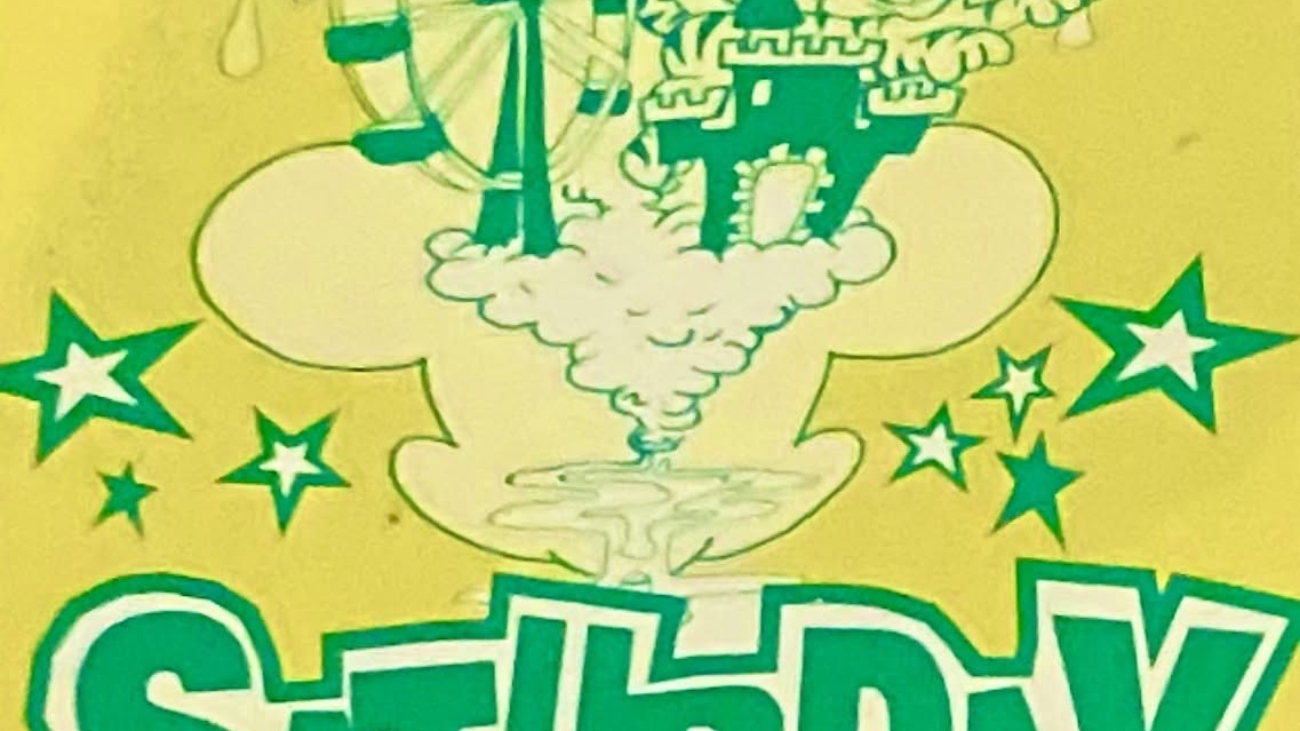
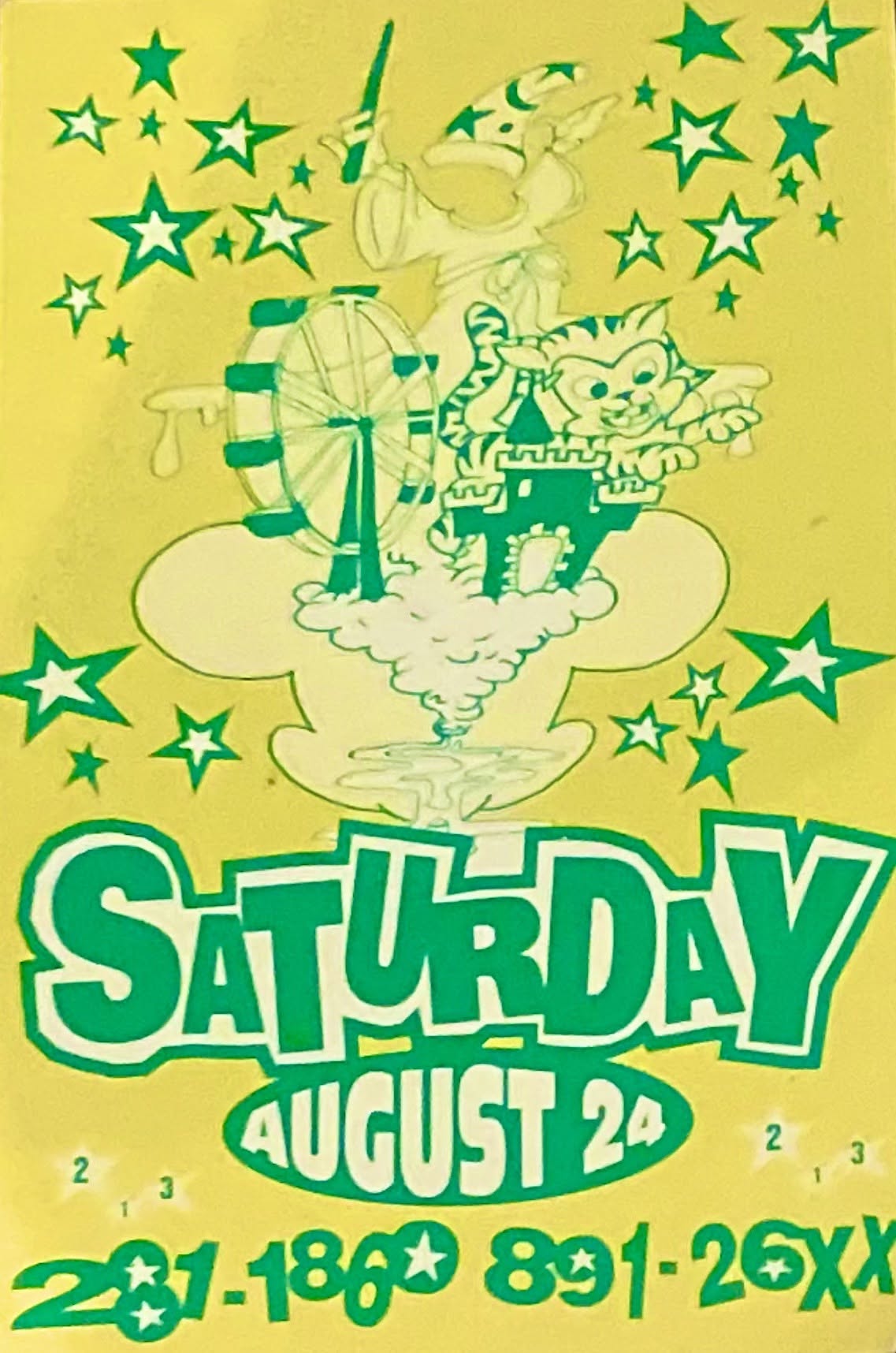
Hauptführ prepared for the first Electric Daisy Carnival the way his crew prepared for everything: by building the decorations themselves. In the downtown Los Angeles loft he shared with several friends and collaborators, the group assembled in the weeks before the event to construct the displays by hand. “We used a lot of found objects, DayGlo, and foam,” said Ken Starks, who was Hauptführ’s roommate and one of the event’s organizers. “We had a blast doing that stuff.” The materials were modest. What they made from them was not. Circus tents. Psychedelic visual enhancements. Flyers printed with 1970s-inspired bubble lettering that looked nothing like the dark, gothic imagery associated with European warehouse raves. Hauptführ’s design instinct drew from his childhood obsession with Alice in Wonderland and other fantasy worlds, and it showed in every detail of what the team created.
He also wore a costume. Specifically, a slightly demented-looking, unauthorized Mickey Mouse outfit, which he wore while walking through the party greeting ravers. This was the “Magical Mickey” of the event’s full name, a character at once playful and deliberately unsettling, a mascot that lived right at the edge between whimsy and something stranger.
The event drew somewhere between 3,000 and 3,500 people to that field outside Chino. For 1991 Southern California rave culture, that number was substantial. Jeanie Chang, who had been attending Hauptführ’s underground parties since before the first EDC and sometimes helped organize them, described the reaction: “When Steve threw the first one, it was groundbreaking. It blew everyone’s minds, and everyone had a great time. It was revered as one of the coolest events that happened back then.”
What made it different from the warehouse raves that had preceded it was not the size. It was the ambition of the experience. The 1991 EDC flyer advertised carnival rides alongside the DJs, including a Ferris wheel and a tornado ride. That detail matters more than it might initially appear. No other major American rave had consciously married mechanical amusement rides to electronic music culture as a core premise of the event. The rides were not an add-on or an afterthought. They were the point. Hauptführ wanted the event to feel like a carnival, like a fantastical world that you entered and that operated by different rules than the one outside the gates.
That idea, planted in a cow pasture in 1991, is exactly what EDC Las Vegas is today at 80 million times the scale.
Hauptführ ran the Electric Daisy Carnival concept through 1992, 1993, and 1995, including a 1992 edition held near El Mirage Dry Lake in California’s Mojave Desert, each event building on the template the first one established. During this same period, a young promoter named Pasquale Rotella was working on Hauptführ’s street promotional teams, distributing flyers and map points, learning the mechanics of how underground events reached their audience. Rotella absorbed everything. By the mid-1990s, he had founded his own production company, Insomniac Events, and in 1995, through a deal negotiated with Rotella’s partner Philip Blaine, the Electric Daisy Carnival name was formally licensed to Insomniac. Richards would later dispute the details of that arrangement in a 2015 trademark action, but the practical outcome was clear from the start: Insomniac now held the brand.
In 1997, Rotella’s version of EDC debuted at the Shrine Expo Hall in Los Angeles, a 5,000-capacity venue, with tickets priced at $20. It was the first iteration of the festival under Insomniac’s management, and it carried forward the carnival rides, the whimsical aesthetic, and the community-centered ethos that Hauptführ had originated six years earlier. After a one-year gap in 1998, the festival resumed at the Lake Dolores Waterpark in Newberry Springs, California. It migrated through a series of Southern California venues over the following decade, from the NOS Events Center in San Bernardino to the Los Angeles Memorial Coliseum, before relocating permanently to the Las Vegas Motor Speedway in 2011.
There is a straight line from the circus tents Hauptführ constructed in a Downtown LA loft to the kineticFIELD production that now requires more than 30 heavy transport trucks to deliver its structural foundation to the Nevada desert. The aesthetic logic is identical: transform a raw piece of geography into a world that operates by its own rules, make the carnival rides as central as the music, and fill the visual field with enough handmade wonder that people feel they have entered somewhere genuinely other.
Hauptführ saw it too, when he reflected on the connection between the early DIY events and the global institution EDC became. “You can definitely see parallels,” he said. “If you lay down the two timelines together, they will be pretty parallel.”
For Rotella and Insomniac, the acquisition of Hauptführ’s name was the starting point. What they built from it represents one of the most significant institutional transformations in American entertainment history, from a bootleg-Mickey-themed field party in a cow pasture to a festival that now operates across four continents, sells out in hours, and drew more than 500,000 attendees to the Las Vegas Motor Speedway for its 30th anniversary weekend.
None of which would exist without a group of friends in a downtown LA loft cutting foam, spraying DayGlo paint, and trying to explain to Inland Empire dairy farmers why they needed to borrow a field for a party.
That is the real origin story of EDC Las Vegas. And 35 years later, the whimsy Hauptführ built into the DNA of the first event is still audible in every drop, visible in every carnival ride silhouetted against the desert sky.