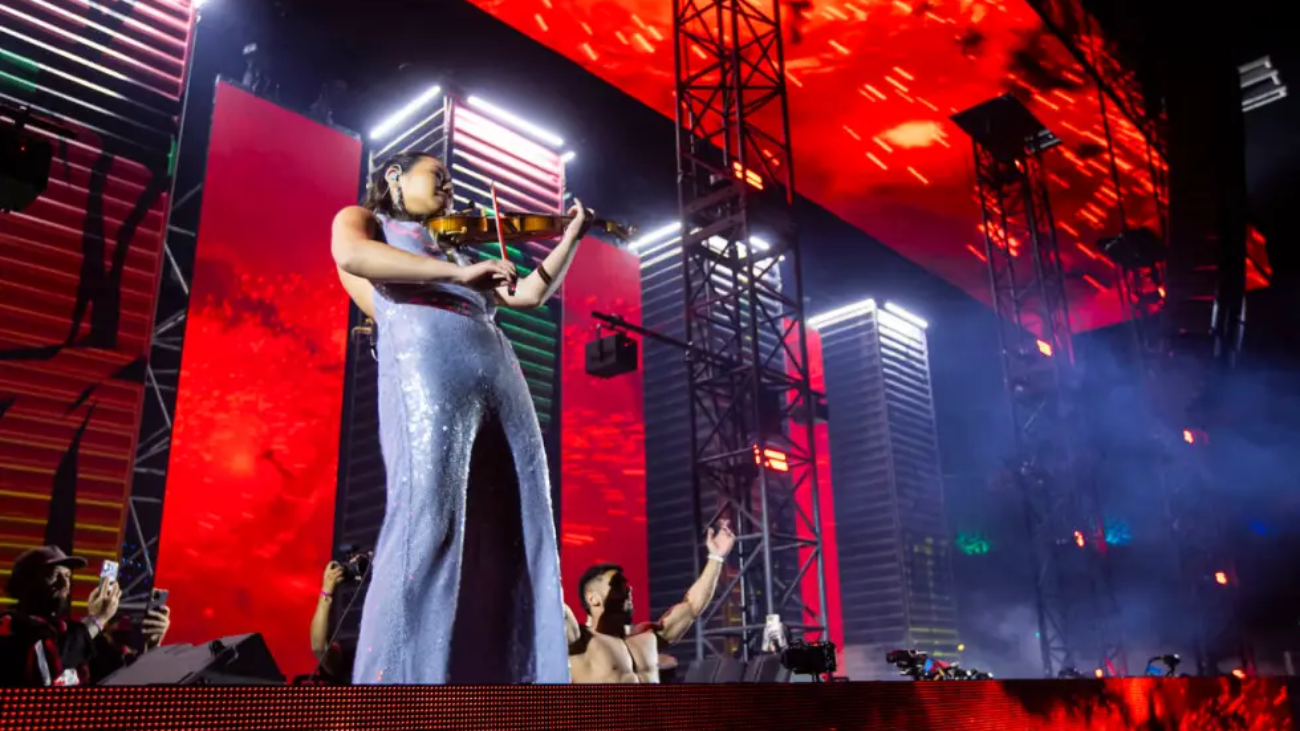
There is something that happens at the Las Vegas Motor Speedway each May that simply cannot be engineered. Insomniac Events can build the most breathtaking stage production on earth, book 200 artists across nine stages, synchronize fireworks to the exact millisecond, and deploy enough lighting infrastructure to illuminate a small city — and all of that is extraordinary, genuinely worthy of every superlative thrown at it. But the moments people actually remember, the stories they are still telling months later in group chats and comment sections and long car rides home, almost never come from the parts that were planned.
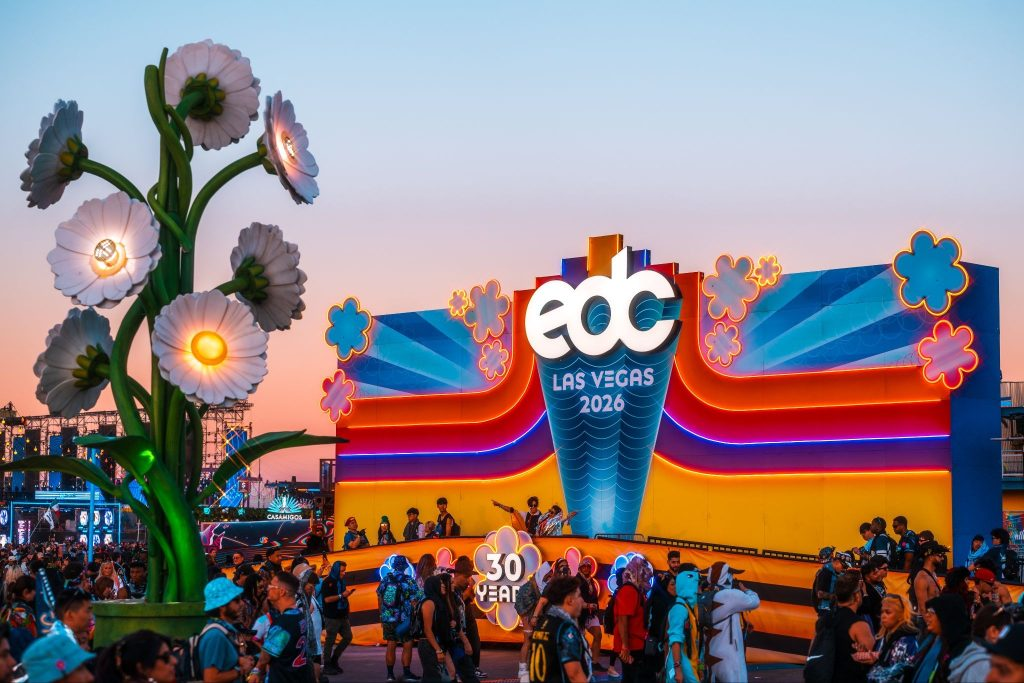
They come from the Pokémon card that landed on a screen in front of 20,000 ravers. From the melodic bass superstar who materialized out of nowhere behind the decks at peak hour. From the coordinated army of Minions that descended on the speedway like some kind of beautiful, chaotic, banana-scented fever dream. From the eccentric pop-art provocateur who looked out at a sea of neon EDC daisy totems and thanked the wrong festival.
The 30th anniversary of Electric Daisy Carnival delivered every superlative the occasion demanded: sold out in record time, half a million attendees across three nights, over 450 artists, a kineticFIELD redesign that left people genuinely speechless, fireworks that painted the desert sky in colors that do not exist in ordinary life. It was, by any objective measure, one of the greatest dance music festivals ever assembled on American soil.
But here is the truth about what it felt like to actually be there: it felt like belonging to something larger than yourself. It felt like the collective creative madness of a community that has been building this world together for three decades, and has long since stopped needing permission to be completely, magnificently unhinged about it.
These are the stories that defined that weekend. The unscripted ones. The ones that spread from phone to phone and person to person until everyone who was not there could feel exactly what it was like to be.
Noizu, 20,000 Ravers, and a Pokémon Pack Opening That the Universe Had Already Decided. House music has many modes of transcendence. There are the four-in-the-morning moments when a groove locks in and time stops. There are the drop-of-silence instants where a thousand people hold their breath before a track explodes back into their chests. And then, in the category of moments that could only happen at EDC, there is what Noizu did somewhere in the middle of his set: he stopped the music, reached into his gear, produced a fresh sealed pack of Pokémon cards, and opened it live on the main screens in front of an audience of over 20,000 people.
What followed was not a calculated stunt. It was pure, participatory chaos of the best possible kind. The crowd that moments earlier had been fully submerged in rolling bass and hypnotic percussion suddenly found itself collectively leaning forward, watching a DJ rip cardboard on a festival screen, reacting to each card reveal with the kind of vocal investment that some headlining sets never achieve. When the pack yielded a rare, high-tier pull — the kind of card that sends collectors into a different stratosphere — the reaction from those 20,000 people was something between a scream and a roar and an extended burst of hysterical collective joy.
It was absurd. It was perfect. It was exactly the kind of moment that encapsulates what EDC actually is beneath all the production value and artist accolades: a space where normal rules about how live music is supposed to behave have been suspended in favor of whatever the moment actually calls for. Noizu’s set was already outstanding. His brand of deep, rolling house music carries a precision and groove density that few producers can match, and the kineticJOURNEY stage design made everything feel larger and more immersive than it would have in any other environment.
But the card pull? That was the moment that got screenshotted, clipped, shared, and referenced by people who were not even at his set. That was the moment that traveled. There is a certain kind of festival magic that occurs when an artist reads a room so perfectly that they abandon the expected gesture entirely and do something completely unexpected instead, and the audience responds not with confusion but with absolute recognition — as if everyone present had been secretly hoping something like this would happen without knowing it. The Pokémon pull was that moment. And when the rare card appeared on screen, the universe clearly agreed.
The Secret Sphere Escape: Illenium’s Unannounced Arrival at the bassPOD. When the GRiZ B2B Wooli set hit its peak intensity on the final night of EDC Las Vegas 2026, something happened that nobody who was standing at that stage has been able to fully explain without their voice rising involuntarily.
For context: Illenium — the melodic bass architect whose emotional, orchestral approach to electronic music has made him one of the most beloved and commercially successful artists in the genre’s recent history — had been in the middle of an enormously high-profile Las Vegas Sphere residency. The Sphere represents an entirely different universe of performance: the most advanced concert venue in the world, built for experiences at a scale that almost nothing else can match. Illenium’s presence there during this same period was not a small booking. It was a statement about where his career existed in the broader cultural landscape.
None of which is why nearly everyone in the bassPOD crowd lost their minds when he materialized behind the decks during the GRiZ and Wooli set, completely unannounced, as if he had simply teleported from the Sphere to the speedway between commitments.
The combination of GRiZ’s funk-infused, melodic energy with Wooli’s prehistoric, cinematic dubstep had already created something volatile and joyful in equal measure — two artists whose sounds occupy different poles of bass music’s spectrum, generating the kind of electric tension that makes the best B2B sets feel genuinely unpredictable. Into that environment, at the precise moment when the set had reached its most intense and forward-moving phase, stepped Illenium. The crowd’s reaction was instantaneous, enormous, and the kind of thing that leaves your ears ringing not from the sound system but from the human beings around you.
What makes this moment particularly meaningful in the broader context of the 30th anniversary weekend is what it represents about EDC’s gravitational pull on artists. The Sphere is not small. Illenium’s residency there was not a side gig. And yet somewhere in the DNA of EDC — in what the festival represents for the community that built dance music culture in the United States, in what it feels like to play to half a million people who have been building toward this specific weekend for months — there is a magnetic force that brings artists back regardless of what else is happening in their careers. Illenium did not need to be at the bassPOD. He chose to be there. And in that choice was something that said more about what EDC means than any press release or production reveal could articulate.
The Day of the Minions: A Coordinated Absurdist Takeover That Nobody Could Ignore. Here is what actually happened on opening night of the 30th anniversary: hundreds of people — some accounts put the number in the thousands — arrived at the Las Vegas Motor Speedway dressed in identical yellow Minion costumes from the Despicable Me franchise. Not loosely inspired by Minions. Not wearing yellow and calling it close enough. Full, committed, coordinated, banana-colored chaos.
The meetup had originated online as a viral fan-organized event that had initially aimed for something even more ambitious — a Guinness World Record attempt — before the logistical realities of executing that level of coordination in the context of EDC’s scale made the official record attempt impractical. But the community behind it showed up anyway, in enormous numbers, because the point was never really about the record. The point was the joke, the commitment, the pure spirit of communal absurdism that has always been one of EDC’s secret ingredients.
What unfolded over the course of that night was one of the most joyful collective performances in EDC history, entirely unrelated to anything happening on a stage. Clusters of Minions descended on the Kandi World dance floor. Banana-suited figures surfaced near the Wasteland stage, where industrial techno and hardstyle were making the earth itself vibrate at frequencies that a Minion has no business being anywhere near. They appeared near the food areas, the art installations, the shuttle queues. A man in a Tony the Tiger costume — fully committed, completely serene — was spotted stretched out on the perimeter grass taking a face-up nap, apparently at total peace with the 140-BPM dubstep rattling the ground beneath him, a tableau of complete and deliberate calm in the middle of everything.
Around them, the rest of the EDC community was doing what it always does: showing up in costumes that represent the full creative imagination of a culture that takes its self-expression seriously. Human disco balls reflected the laser light in every direction. People dressed as naughty Girl Scouts and party-hard popes navigated the crowds with cheerful incongruity. A raving R2D2 wandered the grounds at a frequency that was somehow both completely on-brand for EDC and yet still impossible to fully process. One totem depicted a jacked and wired Mona Lisa, her serene smile replaced by the expression of someone who had discovered a very good bass drop. Another was a fully illuminated Check Engine light, which had clearly diagnosed something in the festival’s spiritual chassis that required immediate investigation.
This is what separates EDC from every other large-scale music event in the world, and what has separated it for thirty years. The community does not come to EDC to watch a show. It comes to be part of one. The art installations and carnival rides and production spectacle are the framework, but the actual event — the thing that happens when half a million people decide collectively that tonight, in this place, the rules of ordinary life are temporarily suspended in favor of something better — is made by the people themselves. The Minions were not a weird anomaly in this tradition. They were its purest expression.
Oliver Tree at the Wrong Festival: A Masterclass in Festival Trolling. The EDC Las Vegas crowd is many things. Passionate, decorated, wildly diverse in its musical tastes and tribal affiliations, deeply committed to the PLUR philosophy that has guided the festival since its origins — and, crucially, extremely quick to recognize and celebrate a well-executed bit.
Which is why what happened during Whethan’s set will be remembered not just by the people who were present for it, but by everyone who saw it on video afterward, and by everyone who simply loves the idea of it in principle.
Whethan — the young electronic producer whose catalogue combines the kinetic bounce of future bass with an instinct for melodic and vocal arrangements that makes his live sets feel consistently joyful and surprising — brought out his longtime friend and creative collaborator Oliver Tree for a guest appearance that had the crowd moving from the first note. The performance itself was everything it needed to be: energetic, tight, fun, the kind of collaboration between two friends who genuinely enjoy each other’s presence on a stage.
And then Oliver Tree did what Oliver Tree does. As the performance wrapped, as the crowd stood there buzzing from what they had just experienced, as the neon daisy totems and illuminated flags and elaborate costumes of 20,000 EDC fans stretched in every direction as far as the eye could see — he looked out over all of it, grabbed the microphone with the authority of a man who has earned his reputation as electronic music’s most deliberate provocateur, and delivered his thanks to “Coachella.”
With a grin.
The response was exactly what it needed to be: a wave of recognition, laughter, and the particular delight that a crowd feels when it is in on a joke that is simultaneously stupid, perfectly timed, and delivered with complete commitment. Oliver Tree did not accidentally say the wrong festival name. He said the wrong festival name with the precision of an artist who understood exactly how the bit would land, in exactly this crowd, at exactly this moment in the performance. The grin confirmed it. The EDC crowd, which has been doing the festival thing long enough to recognize craft when it sees it, responded accordingly.
There is a genre of festival moment that exists at the intersection of performance art and audience provocation, where an artist does something intentionally wrong in a way that is so fundamentally right that it generates more genuine delight than a technically correct gesture would have. Oliver Tree has made an entire career out of inhabiting that intersection. At the 30th anniversary of EDC Las Vegas, he demonstrated why.
What the Unscripted Moments Tell Us About EDC. Step back from the individual stories — the Pokémon pull, the Sphere escape, the Minion army, the wrong-festival shoutout — and look at what they have in common. None of them appear on a setlist. None of them were in the production schedule. None of them were the result of a marketing decision or a creative brief. All of them happened because the specific environment of EDC creates conditions under which the unexpected becomes not just possible but inevitable.
This is not an accident. It is the product of thirty years of intentional community building around a specific set of values. When PLUR — Peace, Love, Unity, Respect — operates not as a slogan but as the actual operating system of an event, it creates a culture in which people feel genuinely free to be strange, generous, creative, and connected in ways that do not occur in ordinary life. Artists feel the energy of that freedom from the stage and respond to it in kind. Fans bring their full, uninhibited selves to the speedway instead of a curated, audience-appropriate version. The result is an event that cannot be fully predicted, even by the people who built it.
The 30th anniversary of EDC Las Vegas was historic for many reasons that will be documented in formal terms: the sold-out attendance, the production achievement of the kineticJOURNEY stage, the announcement of the 2027 two-weekend Dusk Till Dawn expansion, the milestone of three decades as the standard-bearer for American festival culture. All of that matters and will be remembered.
But the 30th anniversary was also historic because of a DJ who pulled a Pokémon card, a melodic bass artist who snuck away from the future of concert technology to join his friends in the desert, a thousand Minions who decided that heavy dubstep is no obstacle to a good yellow-suit photo opportunity, and a troll with a microphone who looked at the whole magnificent spectacle and thanked Coachella for it.
These are the stories that live. These are the ones that make someone who was not there genuinely wish they had been. These are the ones that confirm, thirty years in, that the thing EDC has been building is not just a festival. It is a culture — specific, irreplaceable, and completely its own.
Under the electric sky, the best moments never follow the script. They just happen, and the community makes them matter.
EDC Las Vegas returns in 2027 with its historic two-weekend Dusk Till Dawn expansion — EDC Dusk on May 14–16 and EDC Dawn on May 21–23. Tickets are available now at the official EDC Las Vegas site.