There are years in the life of a festival that feel like checkmarks — another edition delivered, another box ticked on the annual calendar. And then there are years that feel genuinely historic, years where everything aligns into something that demands attention. For Electric Daisy Carnival Orlando, November 2026 is unambiguously the latter.
When Insomniac Events officially announced that EDC Orlando’s 15th edition would carry forward the kineticJOURNEY creative theme from the flagship Las Vegas 30th anniversary celebration, it sent a clear signal: this was not going to be a standard fall festival. It was going to be a chapter. A full-circle moment that connects fifteen years of community-building in Central Florida to three decades of global dance music culture, all expressed through one of the most visually ambitious and emotionally resonant stage concepts that Insomniac has ever put into the world.
This is a deep dive into everything happening at EDC Orlando on November 6–8, 2026, at Tinker Field — from the meaning behind the theme itself and the architecture of the kineticFIELD mainstage to the 100-plus artist lineup, the debut of Hotel EDC on the East Coast, and why this particular edition of the Orlando festival represents something far larger than three nights of music.
Fifteen Years Under the Florida Sky: Why This Edition Is Different
EDC Orlando first opened its gates at Tinker Field in 2011, transplanting the Las Vegas formula into Central Florida with a smaller footprint but the same foundational DNA: PLUR philosophy, immersive stage production, carnival atmosphere, and a musical vision that refused to limit itself to any single genre or corner of the electronic music spectrum. What began as a regional extension of the Las Vegas flagship has spent fifteen years becoming one of the most important dance music festivals in the eastern half of the United States, drawing fans from across the country to Orlando each fall for a weekend that carries the full weight of the EDC brand.
Fifteen editions is a genuine milestone in the festival world. Events that survive a decade and a half while maintaining production standards, expanding their footprint, and deepening their audience relationship are rare. Most either inflate beyond recognition, contract into irrelevance, or simply disappear. EDC Orlando has done none of those things. It has grown steadily, maintained its identity, and become an institution — the kind of event that fans plan their November around years in advance, that creates the shared language and inside references that define a community, that marks time in people’s lives as reliably as seasons.
Insomniac has acknowledged that weight explicitly. The 2026 edition was designed as a dual celebration: fifteen years of EDC Orlando and thirty years of EDC as a global brand. The kineticJOURNEY theme, created originally for the Las Vegas 30th anniversary, was chosen to carry into Orlando precisely because of its meaning — a tribute to the collective path the dance music community has walked together, and a declaration of confidence in what lies ahead. It is a theme about movement, momentum, and continuity, which makes it a natural fit for a festival that has spent fifteen years in motion.
kineticJOURNEY: What the Theme Actually Means
Before getting into the logistics, the lineup, and the specific production details, it is worth spending time on the creative concept at the center of everything, because kineticJOURNEY is not a simple visual motif or a branding decision made in a marketing meeting. It is a fully articulated artistic vision that informs every visual element of the festival from the mainstage architecture down to the costumes of the performers.
Every year, EDC builds its entire festival identity around a single central theme that debuts first at the Las Vegas event in May. The theme determines the design of the kineticFIELD mainstage, the visual aesthetic of the secondary stages, the artwork spread across the festival grounds, the performer costuming, and the overall emotional texture of the weekend. Past themes have ranged across different conceptual territories — organic, celestial, mythological, futuristic — each one leaving its own visual imprint on the collective memory of the EDC community.
For 2026, Insomniac’s design team created kineticJOURNEY specifically to honor a milestone that almost never happens: a festival turning thirty. The concept was built around the idea of movement through time — the passage of three decades of music, community, discovery, and connection, visualized as a journey undertaken collectively by everyone who has ever stood in a crowd at an EDC event. The word “kinetic” carries particular resonance in the EDC universe, where kineticFIELD has been the name of the main stage since the festival’s Las Vegas era, representing the electric, constantly moving energy at the heart of the experience. Pairing that word with “journey” created something that felt both backward-looking and forward-moving simultaneously: a celebration of history that does not settle into nostalgia.
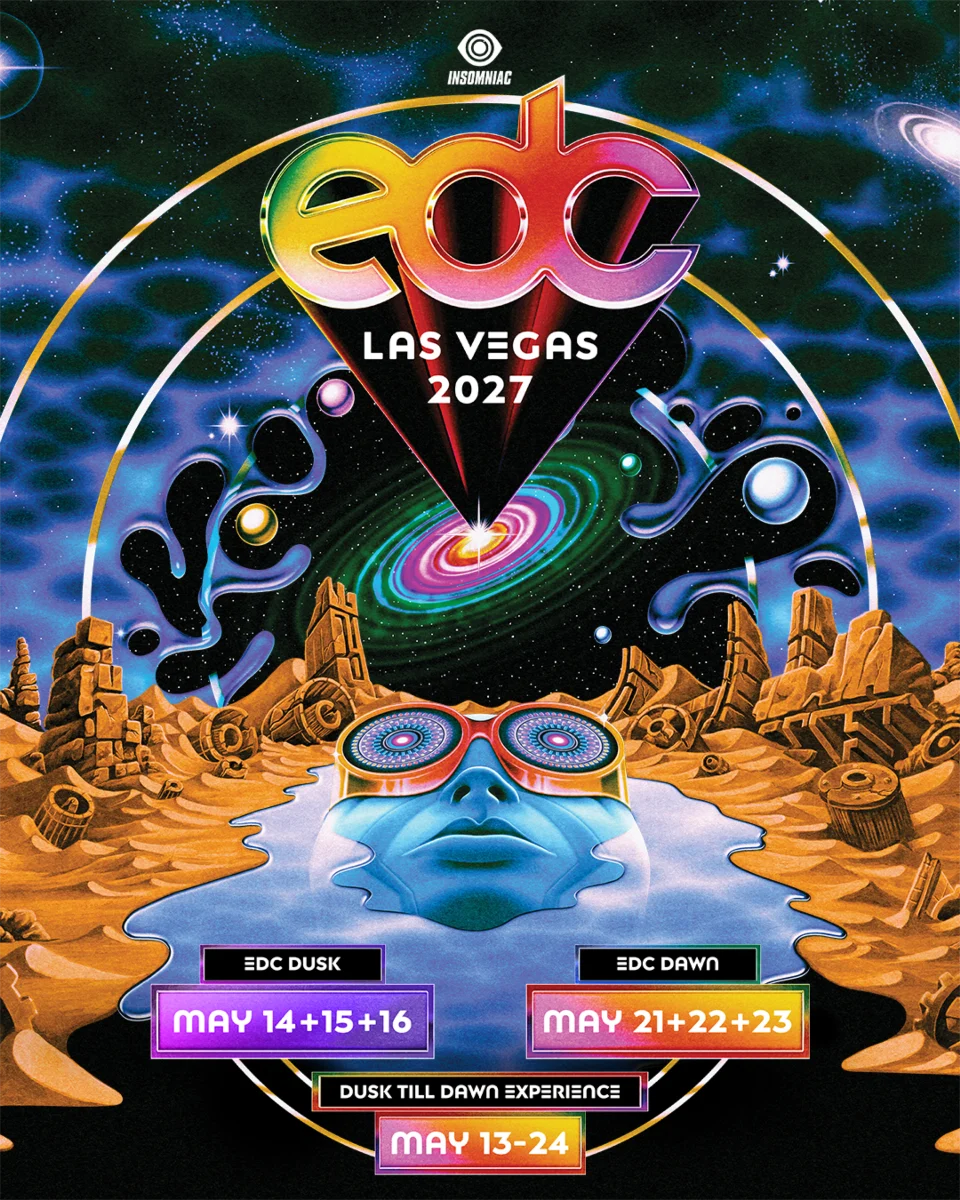
When the theme was introduced at EDC Las Vegas in May 2026 for the flagship’s 30th anniversary edition, it was realized on the kineticFIELD as a production that left attendees stunned. Reviews from the Las Vegas event consistently pointed to the same defining image: a massive sculptural woman’s head rising at the center of the stage, her eyes transformed into glowing goggles that shimmered and pulsed with the music, the entire surrounding structure built to evoke the feeling of a spaceship or a portal — something between a science fiction dream and an ancient temple reinterpreted through futuristic technology. The effect was described by those who experienced it as genuinely otherworldly, a stage that did not feel like a concert venue so much as a place you stepped into, a contained environment with its own gravity and atmosphere. The iconic owl that has anchored previous kineticFIELD designs was absent this year, but its absence only reinforced how fully realized the new concept was — the kineticJOURNEY production did not need a totem because the entire structure was itself a totem, a monument to three decades of culture and the community that built it.
That same production concept is now coming to Tinker Field. For the 15th edition of EDC Orlando, the kineticFIELD mainstage will be built around the kineticJOURNEY design — the same sweeping structural arches, the same dimensional visual panels, the same layered production philosophy, and the same commitment to creating a focal point that functions less like a stage and more like a destination. For Orlando fans who have never experienced it in Las Vegas, this is the first time the full kineticJOURNEY production will exist in their home market. For those who attended the Las Vegas 30th anniversary, seeing it again in the Florida context — surrounded by a different crowd, under different skies, against the backdrop of EDC Orlando’s specific fifteen-year history — will carry its own emotional charge.
The Production Architecture: Mainstage Scale and Technical Ambition
Understanding what the kineticJOURNEY theme means on a logistical level requires understanding what the kineticFIELD mainstage actually is as a piece of engineering and design. This is not a stage in any conventional sense. It is a constructed environment — an enormous, multi-tiered architectural installation that takes weeks to build, requires a fleet of heavy transport vehicles to deliver its structural components, and incorporates audio, lighting, visual, and pyrotechnic systems at a scale that rivals permanent arenas.
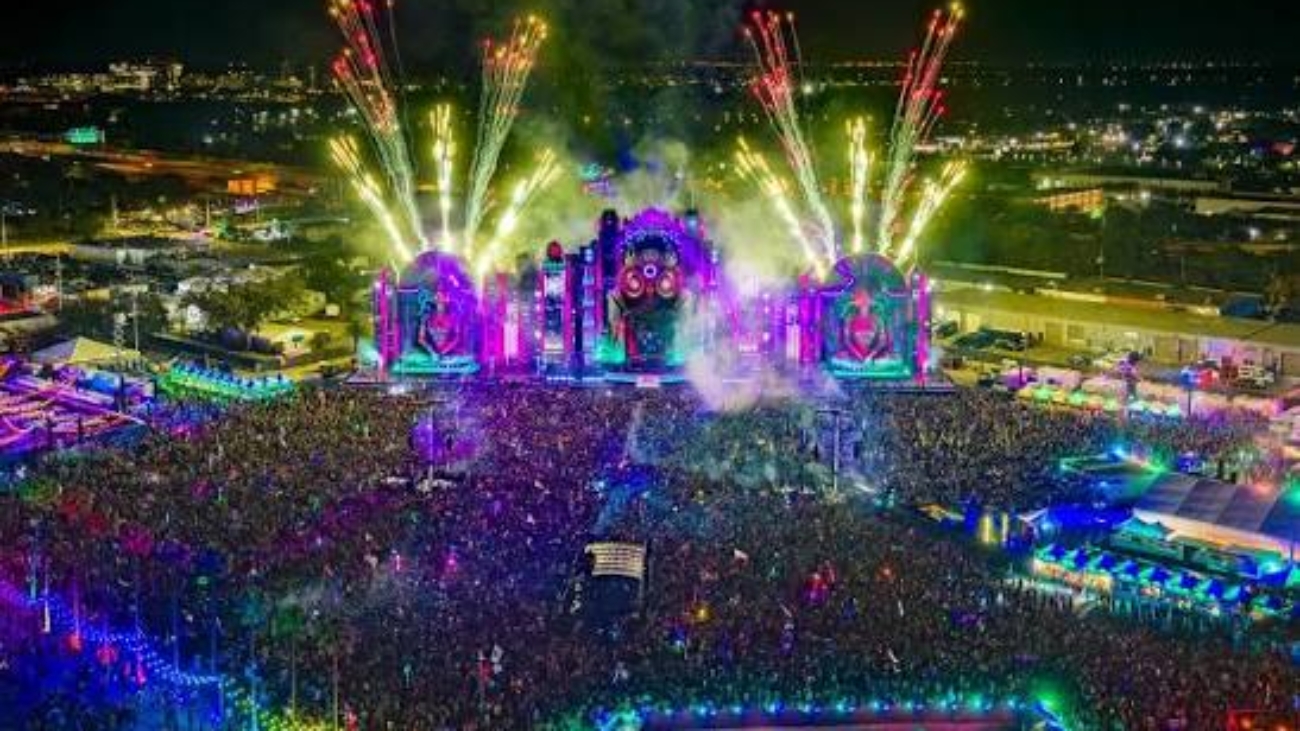
The physical footprint of kineticFIELD dominates the Tinker Field site, establishing the central axis around which the entire festival geography is organized. The DJ booth is embedded within the structure rather than placed in front of it, creating the visual effect of performers existing inside the world the stage creates rather than simply playing to an audience from behind a railing. The LED wall systems that flank and surround the central structure are engineered to deliver resolution and brightness levels that remain vivid even against the pyrotechnic displays that fire throughout each night — a technical challenge that most production companies cannot solve at this scale.
The futuristic time traveler aesthetic that defines kineticJOURNEY pushed Insomniac’s design team toward a sci-fi visual language that feels genuinely cinematic. The production does not simply look impressive from a distance — it creates immersive depth that changes as you move through the crowd. Elements that appear as abstract shapes from the perimeter of the field resolve into specific sculptural details as you approach, creating the sense that the stage is a thing to be explored rather than merely observed. The layered laser systems, which operate throughout each performance, create what is often described as an active depth field in front of the structure — a three-dimensional light environment that extends into the audience space and transforms the area directly in front of the stage into something that feels like the inside of a science fiction environment.
The fireworks displays that accompany the nightly programming at kineticFIELD are among the most significant production elements of any EDC event. These are not background spectacles — they are synchronized components of the musical experience, launched in direct coordination with the music playing at that moment. For a few extraordinary minutes each night, the entire festival pauses collectively as the sky above the speedway erupts in patterns that are calibrated to match the emotional arc of whatever is playing below. The combination of that visual spectacle, the subsonic pressure of the audio system, and the collective experience of thousands of people sharing the same moment simultaneously creates something that is genuinely difficult to communicate in words. It is one of the experiences that EDC veterans cite most consistently when describing why they keep returning.
The Lineup: Over 100 Artists Across Five Stages
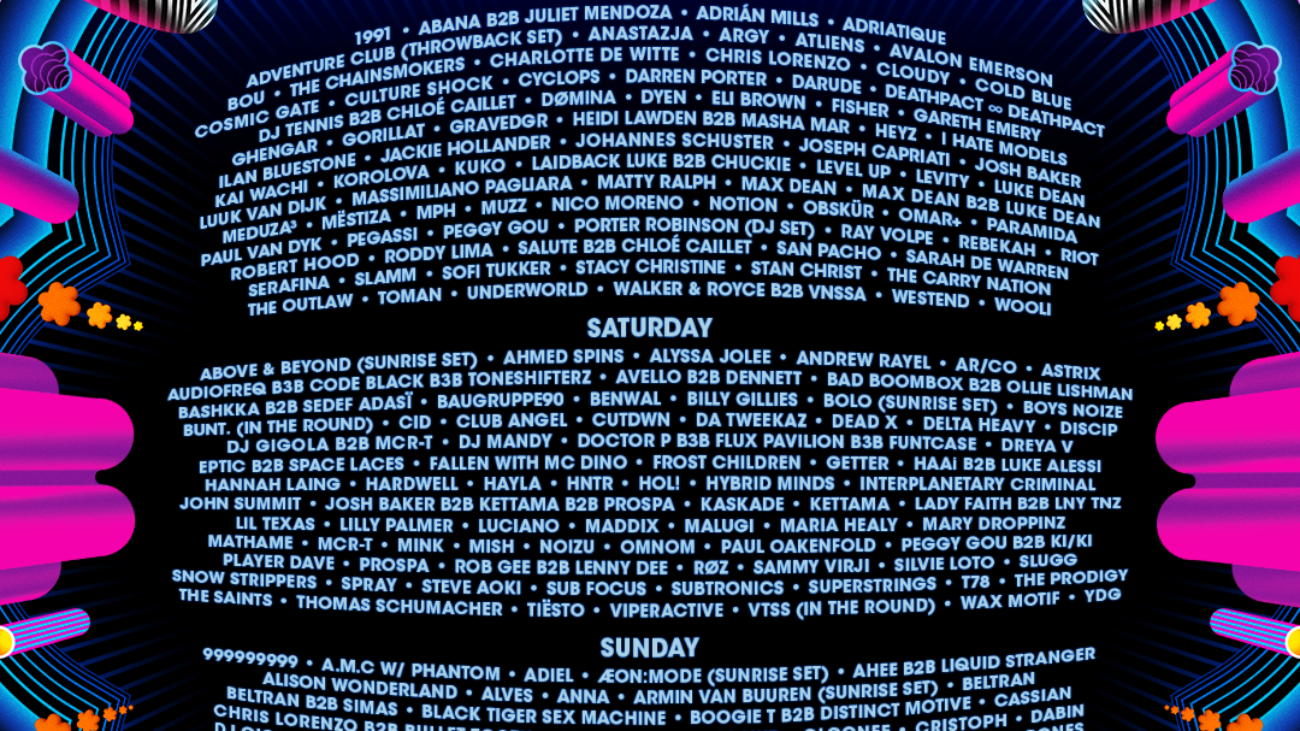
The 2026 edition brings the largest and most genre-spanning artist roster in EDC Orlando’s fifteen-year history. Over 100 acts are confirmed across five stages, representing every major current in electronic dance music from deep house and progressive techno to stadium-scale EDM, bass music, dubstep, and hard dance.
At the top of the bill, the headliner tier reads like a definitive survey of where electronic music sits globally in 2026. David Guetta — a GRAMMY Award-winning producer whose influence on the relationship between dance music and popular culture is essentially impossible to overstate — takes the kineticFIELD alongside Hardwell, whose trajectory from international club-circuit favorite to one of the most technically accomplished and emotionally commanding big-room DJs of the past decade makes him a guaranteed highlight of any mainstage lineup. Martin Garrix, still operating at the peak of a career that has seen him headline virtually every major festival on earth, brings the progressive house expertise and crowd command that has made him one of the defining live performers in the genre. Alesso delivers the melodic, anthemic side of modern electronic music with the kind of precision and energy that transforms festival sets into collective memories. Kaskade — a Chicago-born producer whose career spans the full arc of American dance music culture from underground to stadium — rounds out a headliner tier that represents serious artistic depth alongside obvious commercial power.
The depth below the top-line names is where this lineup becomes genuinely interesting to any fan who pays attention to where electronic music is actually moving. SLANDER, the Los Angeles-based duo whose melodic dubstep productions occupy a unique emotional territory between orchestral pop and heavyweight bass music, bring one of the most distinctive sonic identities on the festival circuit. Alan Walker extends the festival’s reach into the multi-platinum crossover space where dance production meets international pop — his audience includes dedicated EDC veterans and millions of casual listeners who may be discovering the festival world for the first time. Steve Aoki, Afrojack, ALOK, MEDUZA, Alison Wonderland, San Holo, TroyBoi, Mau P, and Wooli give the lineup a breadth that covers virtually every demographic of dance music fan without feeling scattered or incoherent.
The sunset programming tier deserves its own mention, because EDC Orlando has developed a specific culture around its golden-hour sets that makes them a genuinely distinct experience within the festival. As the Florida sky transitions from late afternoon light into the full color display of an Orlando sunset, a curated selection of artists performs in conditions that are both visually magnificent and sonically intimate. Alesso, Alan Walker, SLANDER, Brunello, Malugi, ROSSI., DeVault, and Marlon Hoffstadt are all positioned in this window, creating a lineup within the lineup that has its own emotional trajectory completely apart from the main nighttime programming.
On the underground and crossover side of the roster, the selections for Factory 93 and Bassrush stage programming speak to Insomniac’s ongoing commitment to serving every pocket of the electronic music community simultaneously. I Hate Models, Klangkuenstler, KI/KI, Nico Moreno, and Boys Noize B2B Brutalismus 3000 represent the techno and hard techno contingent — an area of the festival that has grown substantially over the past several years as global audiences have developed appetite for more driving, industrial-inflected sounds alongside the melodic mainstage programming. Prospa B2B Josh Baker and Max Dean B2B Luke Dean represent the house and tech-house world at its current creative peak, while artists including Chris Lorenzo, Dennis Cruz, Franky Rizardo, Omar+, and Kinahau round out a house-music selection that serves fans who want depth of craft alongside spectacle. On the bass side, Ray Volpe, ATLiens, LAYZ, Of The Trees, and a Deorro B2B DIESEL collaboration give the heavier spectrum of the lineup the same care and specificity that the house and techno selections receive.
One of the most structurally important things about a lineup of this size and variety is not any individual booking but the overall design philosophy it reflects. EDC Orlando does not build its program by stacking popular names and hoping the aggregate draws well. It builds a full ecosystem — an interconnected set of musical environments where different communities of fans can spend the weekend in genuinely different experiences, encountering artists they know and discovering ones they do not, moving between stages that feel distinct from each other while being held together by the consistent production quality and community atmosphere that define the EDC universe as a whole.
Five Stages, One Identity: The Stage Architecture of EDC Orlando 2026
The five-stage layout at Tinker Field is both a logistical achievement and a philosophical statement. Each stage serves as its own world — with its own production identity, its own sonic focus, and its own community of fans who gravitate toward it — while the overall festival geography ensures that moving between them feels like exploration rather than transit.
The kineticFIELD mainstage, carrying the full kineticJOURNEY production, anchors the weekend both physically and emotionally. It is the place where the largest moments happen — the headline performances, the midnight fireworks, the collective experiences that 20,000 people share simultaneously and reference for years afterward. The circuitGROUNDS stage, historically the home of harder electronic sounds within the EDC ecosystem, serves as a high-energy counterweight to the mainstage atmosphere, its own visual identity operating in dialogue with kineticFIELD without competing against it.
The Factory 93 stage takeover brings one of Insomniac’s most respected sub-brands into the EDC Orlando weekend in a way that adds genuine programming depth for fans whose tastes run toward the underground. Factory 93 was built specifically to serve the house and techno communities, and its curatorial sensibility carries a specificity that distinguishes it from generic “techno stage” programming. The Bassrush presence serves an analogous function on the bass music side — a brand with its own community, its own identity, and its own history of curation that gives the bass-oriented programming at EDC Orlando a coherence and intentionality that it would otherwise lack. The Insomniac Records stage adds a label-focused dimension to the weekend, creating a direct connection between the festival programming and Insomniac’s recording activities in a way that rewards fans who follow the label’s output closely.
The geographic layout of these five stages across the Tinker Field site creates the natural foot traffic and discovery dynamics that turn a good festival into a great one. Fans who spend the evening rooted at kineticFIELD for a headliner inevitably end up walking past another stage on the way to the exit or the food area, and what they hear often changes their plans entirely. The serendipity of discovering an artist you have never heard in a live environment is one of the most reliable mechanisms of fan development in the festival world, and EDC Orlando’s stage layout is designed to maximize those encounters.
Hotel EDC Orlando: The East Coast Debut of a New Festival Standard
The single most significant new addition to EDC Orlando 2026 — beyond the production theme and the lineup — is the arrival of Hotel EDC on the East Coast for the first time in the experience’s history.
Hotel EDC launched at EDC Las Vegas in 2023 as a response to a growing appetite among festival fans for hospitality experiences that extend and deepen the festival itself rather than simply providing a bed to sleep in. The concept is a full resort takeover — Insomniac transforms a participating hotel property into an EDC-branded destination that operates as its own event alongside the festival. Every element of the guest experience is designed to feel continuous with the main event: the decor, the events, the amenities, the personnel, and the overall atmosphere are all oriented toward the EDC community and the kineticJOURNEY aesthetic.
For 2026, Hotel EDC Orlando is taking over Margaritaville Resort Orlando from November 6–9, coinciding with the full festival weekend and extending one day beyond it to allow guests to decompress without immediately having to re-enter the ordinary world. The property is within practical reach of Tinker Field, making the logistics of getting between the hotel experience and the festival itself manageable without requiring guests to sacrifice time or energy that would otherwise go toward the main event.
The package is comprehensive by design. Every room is outfitted with EDC-specific decor that transforms the standard resort aesthetic into something that feels thematically continuous with the festival grounds. A dedicated Vibee Concierge team operates on-site throughout the weekend, providing festival-specific support, planning assistance, and the kind of personalized service that removes friction from what can otherwise be a logistically demanding experience. Access to exclusive daytime events and after-parties gives Hotel EDC guests experiences that are not available to general festival attendees — a layer of the EDC world that exists specifically for those who have committed to the full immersive version of the weekend. Room packages can be bundled with GA, GA+, or VIP festival passes, and starting prices begin at $1,445 per person for the three-day stay.
This is not incidental to the story of EDC Orlando 2026. The arrival of Hotel EDC on the East Coast signals that Insomniac now sees the Orlando event not just as a regional festival but as a destination — a place that fans from across the country and beyond will make specific travel plans to attend, building their entire experience around the trip rather than simply driving to Tinker Field for the weekend. That shift in positioning has real implications for what EDC Orlando becomes over the next decade. Events that achieve destination status develop a different relationship with their audience, one characterized by higher investment, deeper attachment, and a level of intention that transforms casual attendance into something closer to pilgrimage.
Tickets and Attendance: How to Secure Your Place Under the Electric Sky
Three-day GA, GA+, and 21+ VIP passes for EDC Orlando 2026 went on sale June 25, 2026, at noon Eastern time through the EDC Orlando ticket portal and Front Gate Tickets. Given the 15th anniversary significance, the lineup scale, and the Hotel EDC debut, demand is expected to be strong across all tiers.
GA passes provide access to all five stages and the full festival experience across all three days. GA+ adds enhanced viewing areas, dedicated entrances, and upgraded amenities. VIP delivers the highest level of access, including premium stage viewing positions, dedicated festival services, and the kind of quality-of-life additions that make a three-day festival more sustainable and more enjoyable at every level. For fans considering the Hotel EDC Orlando experience, packages combining hotel accommodations with festival passes are available directly through the Vibee booking portal, and these tend to represent the most streamlined way to lock in both components simultaneously.
The festival runs from November 6 through November 8, 2026, at Tinker Field, located at 287 S Tampa Ave in Orlando, Florida — a historic venue that has been the home of EDC Orlando since 2011 and sits within easy reach of Downtown Orlando and Orlando International Airport. For international travelers, the airport proximity is a genuine operational advantage; for domestic fans traveling from other parts of the country, Orlando’s well-developed tourism infrastructure means that accommodation options extend well beyond Hotel EDC into a broad range of price points and locations.
The Bigger Picture: What EDC Orlando 2026 Represents
Pull back from the specific details — the theme, the lineup, the stage design, the Hotel EDC debut — and what EDC Orlando 2026 represents is a festival that has reached genuine maturity without losing the energy and ambition that defined its first fifteen years.
The kineticJOURNEY theme is, at its deepest level, a statement about the relationship between music and time. The idea that a community can spend thirty years — or fifteen — gathering under the same set of values, the same commitment to shared experience, the same insistence that electronic music deserves the same scale of ambition and the same quality of production as any other form of live art, is genuinely remarkable. Most cultural phenomena of this kind either become institutions so established that they lose their vitality, or burn out before they can reach the kind of longevity that earns them the word “legacy.” EDC has somehow avoided both failure modes, maintaining the energy of a living, evolving cultural organism while accumulating the history and depth of something that has earned its place in the landscape.
Carrying the kineticJOURNEY theme from Las Vegas to Orlando is not simply a branding decision. It is a statement that Orlando is not a satellite of the EDC universe — it is a full node within it, a place with its own community, its own fifteen-year story, and its own claim on the larger narrative that the theme is meant to represent. The Headliners who have attended EDC Orlando since 2011 are as much a part of the kineticJOURNEY as anyone who has ever stood at the Las Vegas Motor Speedway. Their experiences, their memories, their relationships with each other and with the music — all of that is what the theme is actually about.
For first-time attendees, the 2026 edition is as strong an entry point as has ever existed in EDC Orlando’s history. The production quality, the lineup breadth, the Hotel EDC experience, and the anniversary context combine to create a weekend that will be referenced and remembered for years. For veterans of the event, this is the kind of anniversary edition that validates the investment of time and attention and loyalty that festival fandom actually requires — the kind of year that confirms why you kept coming back.
Fifteen years is a long time to spend building something. The community at EDC Orlando has done that building one weekend at a time, one night at a time, one shared moment at a time — under the Florida sunshine, with the music loud enough to feel it in your chest and the lights bright enough to see from miles away. In November 2026, that fifteen-year journey gets its proper celebration, and the kineticJOURNEY begins its next chapter.
Under the electric sky, it always does.
Three-day GA, GA+, and 21+ VIP tickets for EDC Orlando 2026 are available now through the official EDC Orlando site and Front Gate Tickets. Hotel EDC Orlando packages at Margaritaville Resort Orlando, including bundled festival pass options, are bookable through Vibee. The festival takes place November 6–8, 2026, at Tinker Field in Orlando, Florida.