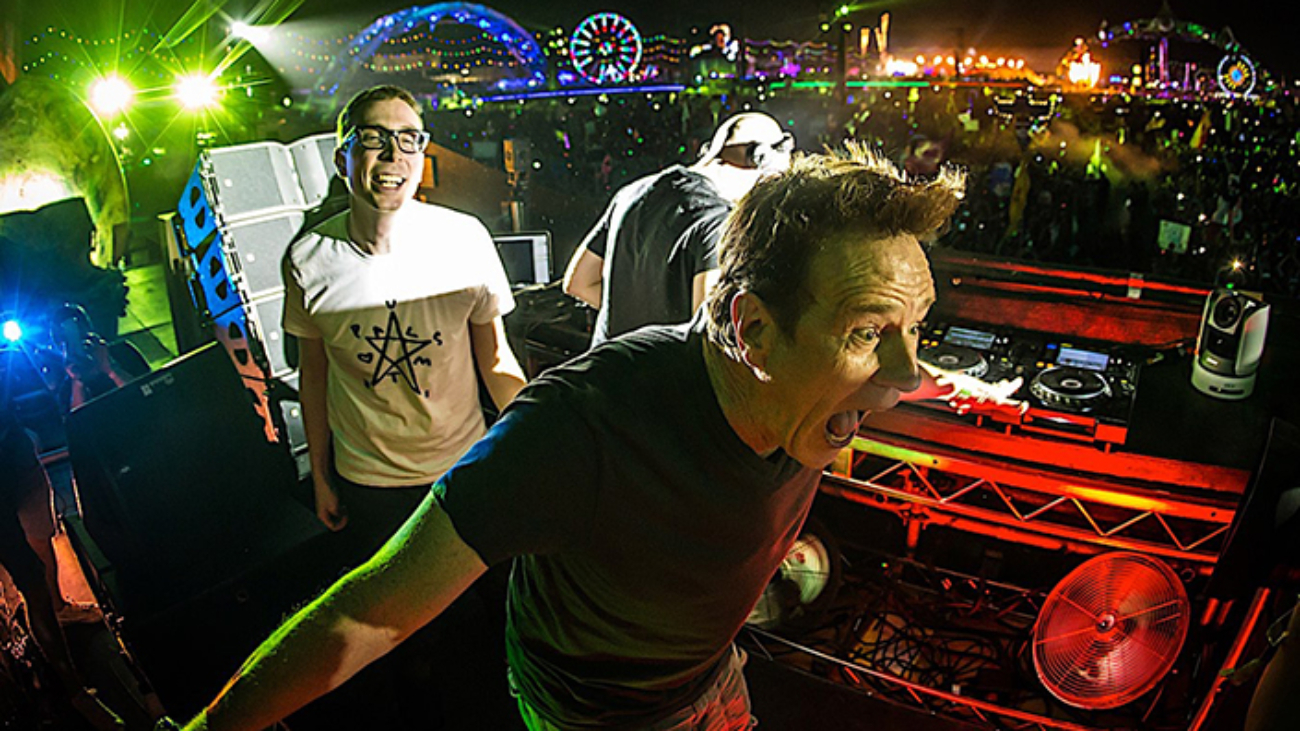
There are moments in live music that exist in two separate timelines simultaneously: the world before they happened, and the world after. The night Bryan Cranston walked to the front of the kineticFIELD stage at EDC Las Vegas 2015, looked out at 80,000 ravers, and growled “Say my name” into a microphone before physically slamming the button on Above & Beyond’s decks is one of those moments. It arrived without warning. It belongs permanently to the culture. And it almost did not happen at all.
What most people know about this moment is what they saw on video: a four-time Emmy Award-winning actor, still reverberating with the cultural weight of one of the most celebrated television performances in the medium’s history, stepping into the role of Walter White one more time in the most improbable venue imaginable. What most people do not know is the full story of how it came together, which involves a hockey player, a text message, a dinner at a Mexican restaurant, a helicopter, and Above & Beyond’s entire setlist being rebuilt from scratch in under two hours.
Who Above & Beyond Are, and Why “Push the Button” Matters
To understand the magnitude of what happened that night, it helps to understand who Above & Beyond are and what the “Push the Button” ritual actually means to their audience. The British trance trio, consisting of Jono Grant, Tony McGuinness, and Paavo Siljamäki, has spent more than two decades building one of electronic music’s most devoted global followings. Their label, Anjunabeats, launched in 2000 and became a cornerstone institution for trance and progressive music, responsible for launching or developing the careers of dozens of artists who now headline festivals worldwide. Above & Beyond themselves have played Madison Square Garden, sold out arenas across multiple continents, and developed a reputation for live performances that routinely produce the kind of emotional intensity usually associated with stadium rock rather than dance music.
The “Push the Button” ritual is the centerpiece of their live experience. At the peak of the set, the group invites a fan from the front row of the crowd to climb up to the stage, stand behind the decks, and physically press the button that drops the night’s biggest track. It is a gesture of pure democratic generosity, the kind of thing that makes a show feel participatory rather than performative, and it creates an intimacy that is unusual at events of this scale. The fan who gets chosen becomes, for one moment, the person who drops the music for thousands of people. The crowd goes through it with them.
In 2015, Above & Beyond had a track in their catalogue called “Walter White,” a piece of music they had written as a tribute to the Breaking Bad character who had dominated American pop culture for years and concluded his arc in September 2013 with one of the most-watched drama finales in cable television history. The song bore the character’s name. The character’s name was synonymous with one actor. What nobody had yet imagined was what would happen if that actor came to an EDC and pushed the button during his own song.
The Mexican Restaurant, the Hockey Player, and the Text That Started Everything
Dustin Penner is a two-time Stanley Cup-winning NHL forward who is also, somewhat unexpectedly, a deeply committed progressive trance fan. He had been friends with the members of Above & Beyond since connecting with them on Twitter years earlier, a relationship that had grown to the point that he toured on the bus with them for three weeks. He was at EDC Las Vegas 2015 as a regular attendee, at a pre-festival dinner with roughly 25 people at a Mexican restaurant near the venue.
At that dinner, through a mutual friend named Eric who was attending with his partner Jania Lee, Penner found himself sitting across from Bryan Cranston, who was in Las Vegas to participate in a documentary about the electronic music world that was intended for the Sundance Film Festival circuit. Cranston arrived, introduced himself to the table, and proceeded to spend thirty minutes talking to Penner about hockey, the Los Angeles Kings, and the New York Rangers before the conversation shifted to what they were both doing at EDC.
When Penner told Cranston they were going to see Above & Beyond, something clicked. Sitting next to Penner at the dinner was Ilan Bluestone, an Anjunabeats producer and longtime member of the Above & Beyond extended family. The two of them looked at each other and arrived at the same idea simultaneously: the group had a song called “Walter White.” What if the actual Walter White pushed the button during it?
Penner took out his phone and texted Jono Grant. The reply came back quickly: “I don’t do requests.” Penner responded that it was not his request. It was Heisenberg’s. And that they should probably do what he says. Grant’s next message conveyed something closer to stunned excitement. From that point forward, the machinery started moving.
Above & Beyond’s manager, James Grant, called Penner and began working through the logistics of what this would actually require. The band had not planned “Walter White” for their set. Adding it meant rebuilding their entire performance structure from the ground up with roughly two hours before they were scheduled to go on at midnight. Penner was in a helicopter leaving for the venue at 11 p.m., still on the phone with management, relaying Cranston’s commitment. The actor had given a characteristically direct response when Penner asked him directly: “Yeah, no problem.”
The logistical challenge of what the band pulled off in those two hours is genuinely underappreciated in retellings of this story. Rebuilding a festival headlining set at the last minute is not a small adjustment. The lighting cues, the visual production synchronized to specific tracks, the sequence and pacing of the set’s emotional arc, the technical setup for the button push itself, all of it had to be reconfigured around a song that was not originally in the plan, by a group performing for tens of thousands of people in under two hours. They did it.
The Moment Itself
When Above & Beyond took the stage at kineticFIELD, the crowd had no idea what was coming. The button push ritual was expected at some point in the set, as it always is. The expectation is that a fan from the front row gets selected, because that is always what happens.
Instead, Bryan Cranston walked out. He had been waiting offstage, out of sight, the secret held through the entire evening by everyone who knew. The crowd’s reaction when they realized who was standing at the microphone was immediate and seismic. Cranston did not ease into it. He looked out at the field of neon and lasers and tens of thousands of ravers and delivered Walter White’s most famous line with complete commitment: “Say my name.” The crowd, which was already processing the fact that Breaking Bad’s leading actor had appeared on a trance festival stage, erupted. Cranston then shouted his character’s name and slammed his hand down on the decks as the drop hit. He jumped up and down with a genuine joy that his own bodyguard had told him he would not do. When he came down from the stage, Penner greeted him with the evidence. “You were jumping a bit, eh?” Cranston just started laughing.
The moment was everything the live radio stream exists to capture. It spread to every corner of the internet within hours and has never really stopped circulating, resurfacing regularly on social media as new generations discover it and older ones share it again with the same enthusiasm they brought to it a decade ago. What made it land so completely was not just the surprise or the cultural weight of the character, but the sincerity of it. Cranston had been in a documentary about electronic music. He had spent the evening at dinner talking hockey before ending up at a festival stage. He said yes because he meant it. When he pressed that button and the music dropped, his reaction was not a performer hitting a mark. It was a person genuinely experiencing something they had not anticipated.
Why This Story Still Matters a Decade Later
The Bryan Cranston moment at EDC Las Vegas 2015 is often cited as the single most celebrated surprise guest cameo in festival history, and the claim holds up to scrutiny. It works on every level that a crossover pop-culture moment needs to work on. The conceptual fit was exact: an actor defined by one role pressing a button during a song named after that character. The timing was perfect: Breaking Bad had concluded two years earlier at the peak of its cultural saturation, so Cranston and Walter White were still everywhere in public consciousness. The emotional execution was genuine on every side. Above & Beyond’s band and management scrambled to make it happen out of real excitement, not obligation. Cranston committed to the bit fully. The crowd’s reaction was completely unperformed surprise because nobody knew it was coming.
What it also represents, beyond the specifics of that night, is something fundamental about what EDC Las Vegas has always been capable of generating. The festival creates conditions in which the genuinely unexpected becomes not just possible but probable. It draws together people from every corner of culture under a shared value system built on openness, creativity, and the willingness to participate fully in whatever the moment calls for. A two-time Stanley Cup winner connected an Emmy Award-winning actor to a British trance trio through hockey conversations and a dinner table, and three hours later, Walter White pressed the button in front of 80,000 people. That chain of events could only have assembled itself inside the specific atmosphere that EDC produces.
It is also, crucially, the kind of story that does not exist anywhere else in festival culture because almost nowhere else in festival culture are the conditions right for it to occur. The combination of live radio streaming that captures every set in real time, the open-door communal atmosphere that makes unexpected encounters between world-famous people and regular festival attendees a normal part of the experience, and the scale of the event itself, large enough that nearly anything is possible, creates a permanent state of potential. Every year, the EDC Live stream carries that potential directly to listeners worldwide who are there precisely because you never know what will happen next.
The Cranston moment is the gold standard. It remains so. And it came together because a hockey player teased Heisenberg about jumping at a festival, a trance trio rebuilt their whole set in two hours out of pure excitement, and an actor who could have been anywhere in the world that weekend decided to say yes to a Mexican restaurant dinner at EDC Las Vegas.
Under the electric sky, that kind of thing happens.