Electric Daisy Carnival is no longer simply expanding. It is fundamentally redefining what a modern global music festival can become. In one of the most ambitious live entertainment announcements in dance music history, EDC Las Vegas officially revealed that the 2027 edition will evolve into an unprecedented 12-day experience spanning two consecutive festival weekends across Las Vegas under a new “Dusk Till Dawn” format that could permanently reshape the future of large-scale electronic music events worldwide.
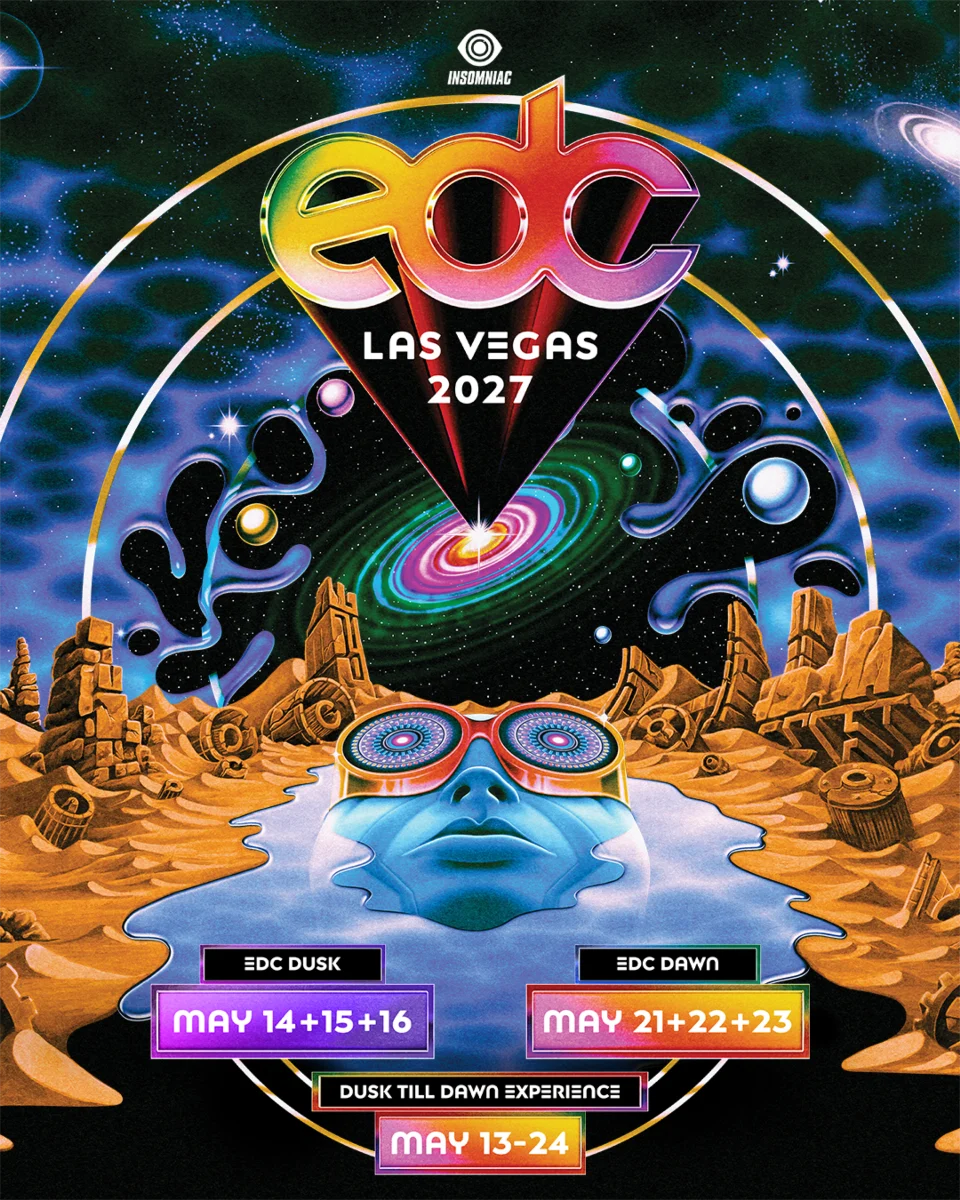
The announcement instantly sent shockwaves throughout the global EDM community because the scale of the transformation is unlike anything the festival industry has previously attempted. Rather than increasing capacity or simply adding another stage configuration, EDC is effectively splitting its iconic Las Vegas experience into two distinct three-day festival weekends — EDC Dusk running May 14 through May 16 and EDC Dawn taking place May 21 through May 23 — while simultaneously creating a continuous citywide celebration extending from May 13 through May 24.
The move represents far more than a scheduling adjustment. It signals a complete structural reimagining of the EDC experience itself. For years, EDC Las Vegas has operated at the absolute edge of festival infrastructure capacity, drawing hundreds of thousands of attendees into the Las Vegas Motor Speedway while simultaneously overwhelming hotel inventory, rideshare systems, highways, airport traffic, and hospitality operations throughout Southern Nevada. The new Dusk Till Dawn expansion directly addresses those pressures while opening the door for an entirely new era of immersive festival design.
Most importantly for fans, the restructuring is being paired with something almost unheard of in modern festival economics: lower attendance caps and lower ticket prices.
That reality alone has become one of the most discussed aspects of the announcement. At a time when music festivals globally continue pushing VIP expansions, premium add-ons, and rising general admission costs, EDC’s decision to intentionally reduce crowd density while lowering pricing represents a dramatic strategic pivot that immediately separates the 2027 edition from nearly every other major festival property in the world.
The Las Vegas Motor Speedway itself is being redesigned specifically around this new philosophy. By dividing attendance between two weekends instead of concentrating the entire global audience into one massive three-day surge, the festival can significantly reduce congestion inside the venue while simultaneously improving transportation flow, entry procedures, viewing areas, shuttle operations, and overall attendee movement throughout the festival grounds.
Anyone who has attended EDC in recent years understands how transformative that change could become. While the scale and energy of EDC has always been part of its identity, crowd density at kineticFIELD, circuitGROUNDS, cosmicMEADOW, and other flagship stages has increasingly become one of the biggest logistical conversations surrounding the event. The 2027 redesign appears engineered specifically to preserve the overwhelming sensory intensity EDC is famous for while dramatically improving comfort, accessibility, and movement throughout the experience.
The names themselves — EDC Dusk and EDC Dawn — also suggest something more creative than merely splitting the festival in half. Early reactions throughout the electronic music community already speculate that each weekend may carry its own unique artistic identity, production direction, stage themes, and even lineup philosophy. While both weekends are expected to feature world-class artist rosters, the branding strongly hints that EDC may begin curating different emotional atmospheres and sonic experiences across each half of the celebration.
That possibility alone has generated enormous excitement because it creates opportunities for the festival to explore multiple dimensions of electronic music culture simultaneously. Dusk immediately evokes darker aesthetics, warehouse energy, underground techno, bass music intensity, neon chaos, and sunset-driven emotional momentum. Dawn, meanwhile, naturally conjures sunrise sets, trance, melodic house, euphoric progressive sounds, spiritual moments, and the emotional catharsis that has long defined EDC’s legendary sunrise culture.
If the festival ultimately leans into those identities creatively, the Dusk Till Dawn concept could become one of the most sophisticated thematic evolutions ever attempted by a major music festival.
What makes the expansion especially significant is how aggressively it repositions Las Vegas itself as the centerpiece of the experience. The full Dusk Till Dawn format officially spans May 13 through May 24, effectively transforming nearly two entire weeks into one continuous EDC city takeover. EDC Week events across the Las Vegas Strip are now no longer simply ancillary nightlife programming orbiting around the festival. They become integrated chapters within a unified entertainment ecosystem stretching across resorts, pool parties, dayclubs, casinos, afterhours venues, and pop-up activations throughout the city.
For Las Vegas tourism and hospitality industries, the implications are enormous. Instead of one hyper-concentrated festival weekend placing maximum strain on infrastructure, the city now receives a sustained tourism surge spread across nearly two weeks. Hotels, restaurants, transportation systems, casinos, nightlife venues, and local businesses all benefit from a more distributed economic wave while potentially avoiding some of the logistical bottlenecks that have historically accompanied EDC weekend.
The restructuring may also dramatically change how international travelers experience EDC. Rather than flying into Las Vegas for a compressed three-day sprint before immediately departing, many attendees may now choose extended stays encompassing both weekends and the days in between. The result could resemble something closer to a global electronic music residency than a traditional festival format.
The ticketing structure itself reflects that philosophy. One-weekend general admission passes begin at an all-in price of $399.99, while full two-weekend Dusk Till Dawn passes start at $599.99 all-in. In the context of modern festival pricing, the two-weekend option is particularly aggressive because it essentially positions the second weekend as a heavily discounted expansion rather than a separate premium experience.
Even more notable is the return of ultra-accessible payment plans beginning with only a $5 deposit. That decision appears strategically designed to reopen accessibility for younger fans and longtime ravers who have increasingly found themselves priced out of major festival culture as live entertainment costs exploded across the industry over the past several years.
The response was immediate. Early-tier passes reportedly sold out in under twenty-four hours after going on sale May 22, 2026, reinforcing just how massive global demand remains for EDC Las Vegas even amid broader uncertainty surrounding the future of large-scale music festivals.
Yet perhaps the most fascinating aspect of the 2027 expansion is what it says about the current state of electronic music itself.
For years, EDM festivals largely competed by scaling upward — bigger stages, larger capacities, louder production, more fireworks, more spectacle, more celebrity appearances, and more social media moments. EDC certainly helped pioneer much of that modern mega-festival blueprint. But the Dusk Till Dawn announcement signals something different emerging inside the industry: a pivot toward experience quality rather than simply experience quantity.
The emphasis on reduced crowding, longer immersion, broader city integration, expanded emotional pacing, and lower attendee stress reflects a more mature understanding of what modern festival audiences increasingly value. Fans are no longer simply chasing overwhelming spectacle alone. They are chasing emotional connection, freedom of movement, comfort, atmosphere, community, and deeper forms of escapism.
In many ways, the new EDC structure resembles the evolution of destination tourism itself. The festival is no longer being marketed merely as a concert event. It is becoming a temporary parallel reality — an immersive world operating continuously for nearly two weeks where nightlife, music, fashion, technology, performance art, and travel culture merge together into one giant experiential universe.
That transformation also arrives at a moment when electronic music continues reaching unprecedented levels of global influence. Techno, trance, house, drum and bass, melodic bass, hard dance, and underground club culture have all experienced massive commercial resurgence simultaneously. Rather than shrinking into niche subgenres, dance music culture has become more fragmented, more international, and more creatively expansive than ever before.
The Dusk Till Dawn structure appears perfectly engineered to embrace that fragmentation rather than force every audience into the exact same concentrated experience. Multiple weekends create room for broader experimentation, more artist flexibility, expanded stage programming, deeper genre exploration, and potentially even entirely different visual identities from one weekend to the next.
There is also something undeniably symbolic about the naming convention itself. Dusk and Dawn are transition points. Thresholds. Moments between realities. In many ways, those concepts perfectly describe what EDC has always represented culturally. The festival has never simply been about DJs performing songs on massive stages. At its best, EDC operates as a temporary suspension of ordinary life — a surreal environment where music, lights, exhaustion, emotion, community, fashion, movement, and sensory overload blend together into something that feels almost dreamlike.
Now, for the first time, that dream is no longer confined to a single weekend.
The 2027 edition of Electric Daisy Carnival may ultimately be remembered as one of the most important structural shifts in modern festival history. Not because it became bigger, but because it became smarter. Because it recognized that scale alone is no longer enough. Because it understood that the future of live entertainment may not be about forcing more people into tighter spaces, but about creating deeper, richer, longer-lasting experiences that audiences genuinely want to live inside.
As Las Vegas prepares for nearly two full weeks of nonstop electronic music culture under the Dusk Till Dawn banner, one thing already feels undeniable: EDC is no longer merely responding to the future of festivals. It is actively attempting to invent it.